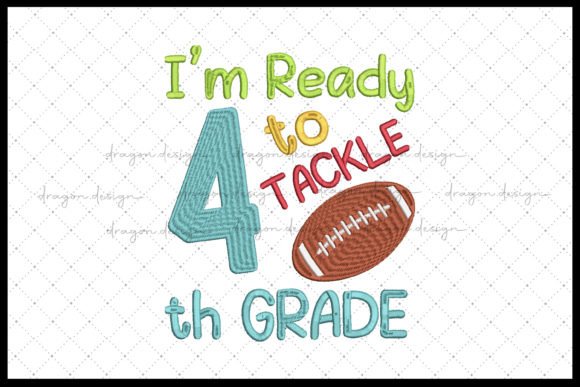
I'm Ready to Tackle 4th Grade
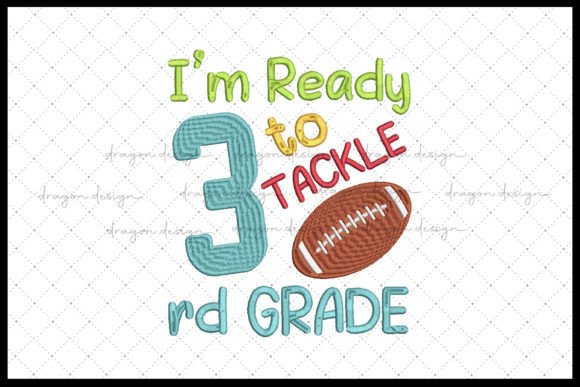
“I’m Ready to Tackle 4th Grade” isn’t just a cheerful phrase—it’s a functional, versatile embroidery design built for real-world use across creative workflows, small business operations, and personal projects. Whether you’re prepping back-to-school gear for your child, launching a seasonal product line, or adding thoughtful detail to custom home decor, this design serves as both a thematic anchor and a practical asset in your digital embroidery toolkit.
At its core, “I’m Ready to Tackle 4th Grade” is a professionally digitized machine embroidery file—designed with balanced stitch density, clean letterforms, and scalable proportions. It’s not a generic font overlay; it’s optimized for stability on varied fabrics (cotton twill, denim, linen blends, and even lightweight knits), minimizing puckering and thread breaks during execution. That attention to technical execution means less troubleshooting mid-project and more reliable output—especially important when batch-producing items like backpack tags, classroom banners, or personalized teacher gifts.
Where This Design Fits in Your Workflow
Think of “I’m Ready to Tackle 4th Grade” as a reusable component—not a one-off decoration. Its value emerges most clearly when integrated into repeatable processes:
- Pre-project preparation: When planning a back-to-school collection, you’ll often finalize themes, color palettes, and messaging before digitizing or cutting fabric. Loading this design early lets you test layout options in your embroidery software (e.g., resizing, mirroring, or pairing with coordinating motifs like pencils, apples, or geometric borders). That saves time later—and prevents last-minute scaling errors on finished garments.
- During production: If you’re running a small embroidery shop or managing school fundraiser orders, having the design pre-organized in multiple formats (.dst, .pes, .jef, .exp, .vp3) means you can drop it directly into different machines without conversion delays. No need to re-digitize or rely on unstable online converters—just select, load, and stitch.
- Post-execution extension: Once stitched onto a tote bag or pillow, the phrase becomes part of a larger narrative—whether that’s reinforcing confidence in a young learner or signaling brand consistency across a series of student-themed products. You can repurpose photos of finished pieces in social media posts, email campaigns, or vendor catalogs, using the same visual language to build recognition.
Compatibility and Setup: Practical Considerations
Before loading “I’m Ready to Tackle 4th Grade” into your workflow, verify three key compatibility points:
- Machine firmware version: Some older Brother or Janome models require specific .pes or .jef versions. Check your machine’s manual—or run a quick test stitch on scrap fabric using the smallest included size (typically 3–4 inches wide) to confirm smooth hooping and thread tension.
- Hoop size alignment: The design comes in multiple sizes (e.g., 3”, 4.5”, 6”)—but only the dimensions that fit within your standard hoop will stitch reliably. For example, if you primarily use a 5” x 7” hoop, avoid the 6” version unless you’ve upgraded to a larger frame. Misalignment causes registration drift or partial stitching.
- Stabilizer pairing: Lightweight cutaway works best for woven fabrics; tear-away suffices for stable cottons. Skip fusible web unless you’re applying the design to non-woven surfaces like cork or felt—where adhesion matters more than stretch control.
Also note: the design includes underlay stitching and strategic jump-thread suppression. That reduces manual editing in software like Wilcom or Embrilliance—but if you’re layering it with another motif (say, a starburst behind the text), disable auto-trim settings to preserve continuity between elements.
Integration Beyond Embroidery
“I’m Ready to Tackle 4th Grade” extends beyond the hoop. Its phrasing and visual rhythm make it adaptable across complementary channels:
- Print-on-demand pairings: Use the vector-based outline (often included in ZIP packages as an .svg or .dxf) to generate iron-on transfers, vinyl decals, or sublimation templates—ideal for customers who want matching mugs, notebooks, or water bottles without embroidery hardware.
- Educational resource alignment: Teachers and homeschoolers can print the phrase as part of goal-setting worksheets or classroom charts. The wording supports growth mindset framing—pair it with blank spaces for students to write their own “I’m ready to tackle…” statements in math, reading, or science units.
- Small business branding: If you sell custom school supplies or learning kits, embedding this phrase into packaging inserts or thank-you cards creates continuity. It subtly reinforces your positioning as supportive, age-appropriate, and pedagogically aware—without needing educational credentials front-and-center.
Workflow Efficiency Tips
To keep “I’m Ready to Tackle 4th Grade” working smoothly over time, adopt these low-effort habits:
- File organization: Store all versions (including backups and resized variants) in a dedicated folder labeled with date and machine type (e.g., ImReady4thGrade_2024_Brother_PES). Add a README.txt noting tested stabilizers and optimal fabric types. This avoids digging through archives when fulfilling rush orders.
- Batch testing: Before starting a 20-piece order, stitch the design on three different base materials—denim, canvas, and poly-cotton blend—to compare density and clarity. Adjust top thread tension by ±0.5 if needed, then document the setting for future reference.
- Consistency tracking: Keep a simple log: date, machine used, fabric, stabilizer, thread brand, and any adjustments. Over six months, patterns emerge—like which thread (e.g., Madeira Polyneon vs. Isacord) holds up best on high-wear items like backpack straps.
- Version control: If you modify the design (e.g., changing font weight or adding a shadow), save it with a clear suffix (ImReady4thGrade_CustomBold) rather than overwriting the original. Preserves integrity for clients who expect the standard version.
Long-Term Use and Quality Control
This design isn’t seasonal fluff—it’s built for reuse across academic years. Fourth grade shifts, but the sentiment remains relevant: readiness, capability, and forward motion. That longevity pays off when you’re curating evergreen inventory or building a library of go-to assets for school-related work.
For quality control, inspect two things after every 5–10 stitches:
- Thread tension consistency—especially at curve transitions in the “g” and “y” letters.
- Edge definition—no fraying or skipped stitches along the outermost satin columns.
If either appears, pause and check bobbin winding, needle age (replace every 8–10 hours of runtime), and hoop tightness. A loose hoop causes micro-shifts that blur fine details—even with perfect digitization.
Finally, consider how “I’m Ready to Tackle 4th Grade” fits into your broader asset ecosystem. Does it complement other grade-level designs you own? Can it be combined with neutral icons (like arrows, checkmarks, or open books) to create tiered messaging—for instance, “I’m Ready to Tackle 4th Grade” + “Next Stop: 5th!”? Building logical groupings like this streamlines future product development and keeps your creative pipeline moving without reinventing core elements each cycle.