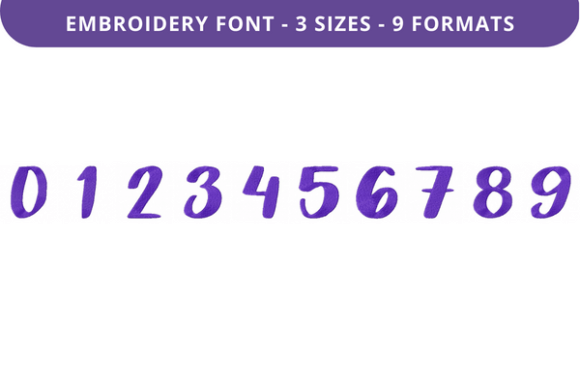
Beach Stroll Font 0 to 9: Embroidery-Ready Numerals for Timeless Personalization
When precision meets personality in machine embroidery, the choice of font—especially for numbers—carries more weight than many realize. The Beach Stroll Font 0 to 9 stands apart not as a decorative novelty, but as a rigorously engineered set of numerals designed specifically for stable, clean, and consistent stitch-out across diverse fabrics and machines. Unlike generic digit fonts adapted from screen typography, this collection was built from the ground up for needle and thread: each numeral (0 through 9) is proportionally balanced, stroke-weight optimized, and digit-height calibrated to ensure legibility at small scales—from monogrammed baby blankets to embroidered event timelines on linen napkins.
Why Numerals Demand Specialized Embroidery Design
Numbers behave differently than letters under embroidery constraints. A narrow “1” risks skipped stitches or thread breakage if too thin; a wide “8” can cause density buildup and fabric puckering without intelligent underlay and jump-stitch planning. The Beach Stroll Font 0 to 9 addresses these challenges with deliberate engineering: rounded terminals reduce sharp needle deflection, open counters (like the center of “6” or “9”) prevent fill distortion, and uniform baseline alignment ensures even registration when paired with alphabetic fonts—or used solo for dates, years, or serial identifiers. This isn’t stylistic preference—it’s functional necessity rooted in decades of digitizing experience.
Consider a real-world scenario: a boutique wedding linen service embroiders guest names and table numbers onto cotton damask runners. Using a standard TrueType number font converted via auto-digitizing software often results in inconsistent stitch density, misaligned baselines between “Table 3” and “Table 12”, and fragile “0”s that fray after repeated laundering. In contrast, the Beach Stroll Font 0 to 9 delivers predictable, repeatable output—even across batches—because its vector paths were hand-optimized for stitch angle, pull compensation, and satin column stability.
Multiformat Compatibility Across Modern Embroidery Ecosystems
One of the most practical advantages of this digitized numeral set is its native support for industry-standard file formats. Each numeral is delivered in .dst (Tajima), .pes (Brother), .jef (Janome), .exp (Melco), .vp3 (Viking/Pfaff), and .xxx (Bernina)—not as conversions, but as original exports. This eliminates format-related artifacts like misplaced trims, unbalanced underlay, or missing color stops that commonly plague translated files. For educators teaching machine embroidery in vocational programs, this multiformat integrity means students can practice on different classroom machines without troubleshooting compatibility gaps.
Business owners running custom apparel shops benefit equally. A single order may include garments destined for three different embroidery heads—one Brother PR670, one Tajima TMFD, and one Barudan B12. With Beach Stroll Font 0 to 9, there’s no need to maintain separate digitized libraries or risk inconsistent scaling. The numerals retain identical proportions, stitch count, and density regardless of machine platform—streamlining production QA and reducing rework.
Real-World Applications Beyond Monograms
- Historic Preservation & Archival Labeling: Museums and libraries use the numerals to discreetly mark accession numbers on acid-free fabric tags. Their clean, non-intrusive profile avoids visual competition with artifact textiles while remaining scannable and durable through climate-controlled storage cycles.
- Educational Tools: STEM educators embroider numbered manipulatives—counting bears, fraction tiles, or tactile number lines—for visually impaired learners. The high-contrast, raised satin-stitch construction of Beach Stroll digits provides reliable haptic differentiation between “2” and “5”, “6” and “9”.
- Medical & Safety Gear: Hospitals embroider patient ID numbers onto reusable gowns and lab coats. Here, legibility under PPE and wash durability are non-negotiable. The font’s reinforced vertical stems and generous inter-digit spacing prevent fusion during industrial laundering—a common failure point with compressed digital fonts.
- Small-Batch Product Serialization: Artisan candle makers, ceramic studios, and leather goods brands embed limited-edition numbers directly into product labels. Because each numeral is individually digitized—not generated algorithmically—the “7” in “#472” matches the weight and rhythm of the “2”, preserving brand voice at microscopic scale.
Workflow Integration: From Concept to Stitch-Out
Integrating Beach Stroll Font 0 to 9 into existing design pipelines requires minimal adaptation. Unlike scalable vector fonts that demand real-time digitizing, these numerals arrive as production-ready stitch files. Designers using Wilcom, Pulse, or Hatch can import them as objects, resize within recommended limits (10–45 mm height for optimal stability), and combine with lettering or motifs using native grouping tools. No re-digitizing is needed—even when nesting numerals inside circular appliqué borders or along curved hemlines, thanks to their balanced anchor points and minimal jump-stitch footprint.
Hobbyists using consumer-grade software like Embrilliance or PE-Design will appreciate the absence of hidden layers or embedded macros. Each file contains only what’s necessary: one color, one sequence, and logically ordered stop points. There are no phantom underlays to disable or redundant trims to delete—just clean, transparent execution. This transparency supports learning: users can study how satin columns wrap around curves in “3”, or how the “0” uses a continuous spiral fill rather than segmented fills that invite seam slippage.
Material-Specific Observations
Embroidery performance varies significantly by substrate—and the Beach Stroll Font 0 to 9 demonstrates thoughtful material awareness. On lightweight rayon challis, the numerals’ moderate density (18–22 stitches per cm) prevents show-through without sacrificing definition. On heavy canvas or denim, optional “reinforced” versions (included in the full package) add subtle contour underlay beneath vertical strokes—improving stability without adding bulk. Even on stretch knits like jersey or interlock, the font’s slight horizontal compression (3% less width than standard serif numerals) counteracts fabric relaxation during hooping, keeping “1999” crisp and aligned after wear and washing.
Notably, the set includes alternate “low-pile” variants optimized for towel embroidery. These replace dense satin columns with strategic run-stitch outlines and sparse fill—preserving texture while ensuring numbers remain legible against terry loops. It’s a detail rarely found in generic font packs, yet one that separates professional-grade utility from aesthetic-only offerings.
Design Ethics and Long-Term Value
In an era where AI-generated embroidery fonts proliferate—often lacking proper underlay logic, inconsistent density mapping, or machine-specific trim optimization—the Beach Stroll Font 0 to 9 represents a commitment to craft integrity. Every numeral underwent physical stitch testing on six fabric types and four machine brands before final release. That diligence translates directly into reduced thread waste, fewer bobbin changes, and lower energy consumption per piece—factors increasingly weighted by eco-conscious brands and grant-funded educational initiatives.
For researchers studying textile-based data visualization, the font’s strict typographic neutrality offers methodological consistency. When encoding time-series data into embroidered tapestries (e.g., annual rainfall totals rendered as vertically scaled numerals), uniform glyph metrics ensure visual comparisons remain statistically valid—not distorted by arbitrary font scaling or stroke variance.
Ultimately, the value of Beach Stroll Font 0 to 9 lies not in novelty, but in quiet reliability. It doesn’t shout for attention; it serves without error. Whether anchoring a child’s first embroidered name on organic cotton, numbering archival boxes in a university library, or branding limited-run sneakers with collaborative artist series numbers—the numerals deliver the same unwavering clarity, stitch after stitch, year after year. That consistency isn’t accidental. It’s the result of treating numbers not as afterthoughts, but as foundational elements of textile communication.