Children Drawing: A Thoughtful Embroidery Design for Meaningful Fabric Personalization
Children Drawing isn’t just a decorative motif—it’s a functional, emotionally resonant asset in the creative workflow of makers, educators, small business owners, and hobbyists who value authenticity and tactile expression. This particular design captures the joyful spontaneity of childhood mark-making: soft lines, rounded shapes, and gentle asymmetry that evoke warmth and sincerity. Unlike highly polished vector graphics or AI-generated patterns, Children Drawing retains the quiet intentionality of hand-drawn simplicity—making it especially effective when translated into stitched form on fabric.
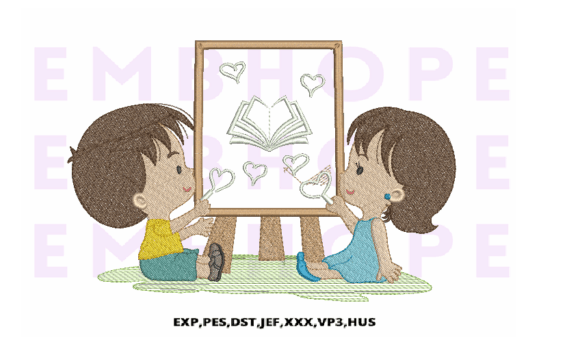
Its primary utility lies in embroidery—not as a standalone art piece, but as an integrated element within larger physical products: custom tote bags for a classroom fundraiser, personalized napkins for a boutique café launch, or embroidered patches for a youth-led community project. Because it’s delivered as a machine embroidery design with multiple file formats (including PES, DST, JEF, and EXP), it plugs directly into common workflows without requiring redesign or digitizing expertise. That compatibility reduces friction between concept and execution—especially valuable when time, consistency, and reproducibility matter.
Where Children Drawing Fits in Your Creative or Business Process
For professionals managing product development cycles—whether launching handmade goods, designing educational materials, or producing branded merchandise—Children Drawing functions best when placed early in the *asset preparation phase*. It’s not something you reach for after finalizing layouts or choosing thread colors; rather, it’s selected alongside fabric swatches, stitch-test samples, and production timelines. Why? Because its inherent charm depends on faithful reproduction—not scaling, stretching, or altering the original geometry.
This means planning begins with understanding constraints: the design’s native size, recommended fabric types (medium-weight cotton, linen blends, or stable denim work well), and hoop size requirements. Skipping this step risks distortion—especially if resizing is attempted post-import. The note “quality cannot be guaranteed when resizing or altering the design” isn’t a limitation; it’s a signal to align expectations with technical reality. Treating Children Drawing as a fixed-resolution component—like a calibrated font or licensed photo—supports consistent output across batches and machines.
Integration Across Tools and Teams
In collaborative environments—say, a school craft club coordinating with a local embroidery service, or a freelance designer handing off files to a production partner—Children Drawing streamlines communication. Its multi-format support eliminates back-and-forth about file compatibility. You don’t need to convert or re-digitize; you simply match the format to the machine brand (e.g., PES for Brother, DST for Tajima). This interoperability supports parallel workstreams: while one person sources eco-friendly organic cotton canvas, another preps the embroidery files, and a third tests stitch density on scrap fabric.
It also interfaces cleanly with inventory and asset management systems. When stored with clear naming conventions—Children_Drawing_v1_PES_120x100mm—it becomes searchable, version-controlled, and reusable. For entrepreneurs running seasonal collections, tagging the design by use case (“back-to-school”, “gift packaging”, “teacher appreciation”) helps surface relevant assets during campaign planning—not during last-minute production crunches.
Practical Implementation Tips for Real-World Use
Start with stitch testing. Even with high-quality files, fabric behavior varies. Run a test on your target material using the exact stabilizer type (tear-away works well for stable weaves; cut-away adds support for knits). Observe how the design fills—especially curved elements like arms or facial features—and adjust top tension only if needed. Avoid changing stitch count or density unless absolutely necessary; the original digitizing balances coverage and breathability.
Organize by application, not just format. Keep folders for “apparel”, “home goods”, and “accessories”, each containing the appropriate file variants plus notes on recommended thread brands (e.g., Madeira Polyneon for vibrancy, Isacord for durability) and average stitch time per item. This turns Children Drawing from a static download into a living part of your production playbook.
Pair intentionally, not decoratively. Children Drawing shines when contrasted with clean typography or minimal backgrounds—not competing with dense patterns or busy prints. On a linen tea towel, place it near a corner rather than centering it; on a child’s backpack strap, orient it vertically to follow the natural line of wear. These micro-decisions compound into cohesive branding and thoughtful user experience.
Long-Term Usability and Quality Control
Because Children Drawing relies on proportion and line integrity, long-term usability hinges on disciplined file hygiene. Store backups in at least two locations—one cloud-based (with version history enabled), one local on encrypted media. Rename edited versions explicitly: Children_Drawing_v1_alt_stitch_test_2024. Never overwrite the original master file. This preserves fidelity across iterations and ensures you can revert if a modified version underperforms.
Also consider environmental variables. Humidity affects thread tension; older machines may require updated firmware to read newer file headers. Periodically re-validate the design on your primary machine—especially before large orders. A 90-second test run prevents hours of rework.
Use Cases That Reveal Its Strategic Value
- Educators: Stitch Children Drawing onto fabric name tags for preschool students—reinforcing identity and belonging through tactile recognition, not just visual labels.
- Small Business Owners: Use it on reusable produce bags sold at farmers’ markets—adding emotional resonance to sustainability messaging without cluttering the message.
- Freelance Designers: Embed it in client style guides as an approved illustrative element for merchandising extensions, ensuring brand voice remains warm and human-centered across touchpoints.
- Hobbyists: Combine it with hand-stitched borders or fabric paint accents to create hybrid pieces—leveraging machine precision for structure and manual work for texture.
None of these applications depend on novelty or trend-chasing. They rely instead on clarity of purpose: Children Drawing serves as a bridge between intention and execution—where care in selection, preparation, and placement translates directly into perceived quality and emotional impact.
That’s why it endures. Not because it’s flashy, but because it integrates cleanly—without demanding extra steps, reinterpretation, or compromise. When your workflow values repeatability, respect for material constraints, and alignment between concept and outcome, Children Drawing doesn’t just decorate fabric. It reinforces how thoughtfully built things feel different—and why that difference matters to people who make, teach, sell, and create with intention.