Old English Font ABC
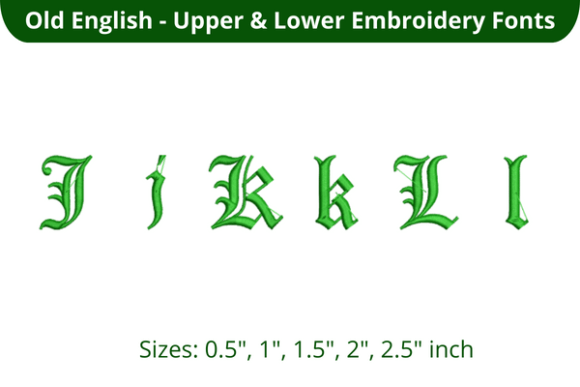
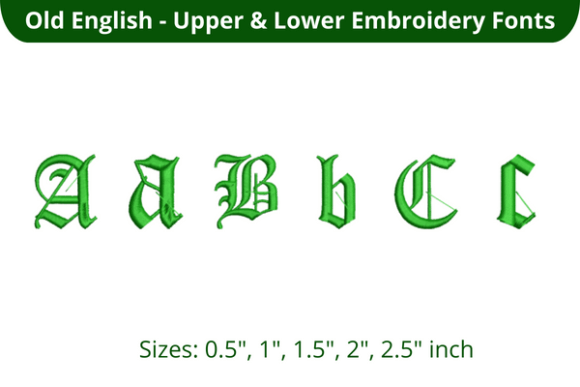
Old English Font ABC is a high-quality embroidery font designed for precision, legibility, and timeless visual impact on fabric. Unlike generic decorative fonts, it’s engineered specifically for machine embroidery—balancing ornate letterforms with stitch stability, thread efficiency, and clean edge definition. It’s not just about aesthetics; it’s a functional asset in your creative or production workflow, especially when personalization, branding, or commemorative detail matters.
Where Old English Font ABC Fits in Your Workflow
This font enters your process at the design-to-production handoff—where digital intent meets physical execution. Whether you’re stitching monograms on bridal linens, labeling artisanal apparel, or adding heirloom-style dates to baby blankets, Old English Font ABC bridges conceptual intent and tactile result. Its role isn’t isolated: it interacts directly with your vector editing software, embroidery digitizing tools, machine firmware, and even your fabric selection and stabilizer choices.
For example, if you’re launching a small batch of custom towels for a boutique client, you’ll likely finalize the layout in Illustrator or Inkscape first—then convert text to outlines before importing into embroidery software. That’s where Old English Font ABC becomes more than a typeface: it’s a calibrated stitch asset. Its letter spacing, kerning pairs, and baseline alignment are pre-optimized so that “A”, “B”, and “C” (and all subsequent characters) maintain consistent density and flow across varying word lengths—even at 0.8-inch heights.
Preparation: Setting Up for Reliable Output
Before loading any design onto your machine, verify compatibility. Old English Font ABC ships with multiple embroidery file formats—including PES, DST, EXP, JEF, VP3, and XXX—covering Brother, Bernina, Janome, Husqvarna Viking, and Tajima machines. Don’t assume your machine reads every format. Check your model’s supported extensions in the manual or manufacturer portal. If you use Wilcom or Embrilliance, import the .DST or .PES version first and run a quick simulation to confirm no overlapping stitches or under-digitized serifs.
Stabilization is non-negotiable. Old English letterforms include fine stems, sharp terminals, and tight counters. On lightweight cotton or knits, use medium-weight cutaway stabilizer. For structured fabrics like denim or canvas, tear-away works—but always test on scrap with identical thread tension and needle size (75/11 or 80/12 recommended). Skip this step, and you’ll get puckering around the “R” or broken satin columns in the “S”. Consistency starts before the first needle drop.
Integration With Design Tools and Platforms
If you use Cricut Design Space or Silhouette Studio, note that Old English Font ABC is not a system font—it’s an embroidery-specific resource. You can’t type directly into those apps and expect stitch-ready output. Instead, use them for layout planning only: position names, dates, or quotes visually, then export as SVG or DXF and import into dedicated embroidery software like Hatch, Embrilliance Essentials, or Pulse. There, you’ll apply the Old English Font ABC character set as individual stitch objects—not live text.
For designers managing recurring client work—say, school spirit wear or corporate gifting—create a template library. Save common configurations: 1.25-inch tall name + 0.5-inch date below, centered on a 4x4 hoop; or stacked initials in 0.75-inch height with 0.08" letter spacing. Store these as .EMB or .PES files with clear naming (e.g., OE_ABC_NameDate_125_SingleLine). That cuts setup time by 60% on repeat orders and reduces human error during scaling or mirroring.
Practical Use Cases Across Roles
- Hobbyists & Makers: Use Old English Font ABC to personalize quilting labels, cross-stitch samplers, or holiday stockings. Stitch “Est. 2024” beneath a family crest motif—then archive the .PES file for next year’s update. Keep a printed cheat sheet of character widths (e.g., “W” = 1.02", “I” = 0.38") taped to your hoop stand for quick width estimation without reopening software.
- Small Business Owners: Integrate this font into your product configurator—if you offer custom embroidery via Shopify or WooCommerce, upload the font’s sample layouts as PNG previews. Customers see realistic spacing and scale before ordering. Pair it with a simple dropdown: “Font Style → Old English ABC (embroidery-optimized)”. This manages expectations and reduces post-purchase revision requests.
- Educators & Workshop Leaders: When teaching embroidery digitizing fundamentals, use Old English Font ABC as a case study. Compare how its lowercase “g” handles loop closure versus a generic script font. Show students how adjusting underlay density changes fill stability in curved strokes. Real-world assets reinforce technical concepts faster than abstract examples.
Quality Control and Long-Term Usability
Inspect every stitched sample—not just for accuracy, but for wear resilience. Run a gentle wash-and-dry cycle on test pieces. Observe how the “M” holds its apex, whether the “O” retains circular integrity, and if thread ends remain buried after trimming. Document findings in a shared team spreadsheet: column headers like Fabric Type, Stabilizer Used, Observed Distortion Points, and Recommended Max Height. Over time, this becomes your internal quality benchmark—not reliant on vendor specs alone.
Version control matters. If you modify the original Old English Font ABC files—say, adjusting kerning for a specific client logo—save the altered version with a suffix (OE_ABC_NameDate_CustomKern_v2) rather than overwriting the master. That preserves integrity for future projects and enables quick rollback if results degrade.
Efficiency Without Compromise
You don’t need to digitize every variation from scratch. Old English Font ABC includes full uppercase A–Z, numerals 0–9, and common punctuation (., !, &, '). For short quotes (“Forever & Always”, “Est. 1987”), build phrases directly in your embroidery software using the included characters. Avoid converting full sentences in vector editors first—that often introduces unintended spacing shifts or outline inconsistencies.
When scaling, never stretch horizontally or vertically. Scale uniformly—and always check final dimensions in millimeters within your software’s measurement panel. A 10% horizontal stretch may make the “E” look sturdy but will distort the “B”’s lower bowl, causing thread breaks mid-stitch. Trust the font’s native proportions.
Final Integration Tip: Build Around Intent, Not Just Aesthetics
Old English Font ABC excels when its purpose aligns with context. It’s ideal for formal, ceremonial, or legacy-driven applications—not fast-turnaround promotional items where readability at distance matters more than tradition. Ask yourself: Does this project benefit from gravitas? Is permanence part of the value proposition? If yes, this font earns its place. If you’re embroidering safety vests for a construction crew, choose something bolder and wider-spaced instead.
Ultimately, Old English Font ABC functions best when treated as a precision tool—not decoration. Its value emerges in consistency across batches, reliability across fabric types, and fidelity to design intent through every stage: from screen to hoop to finished garment. That’s how it supports real work: quietly, accurately, and without demanding constant adjustment.